

Bridges must be able to withstand several types of forces. The two most common to model bridges are compression and tension, pushing and pulling respectively. The other two are torsion (twisting) and shear. Learn what these forces mean so that you can build a better model bridge.
Compression:
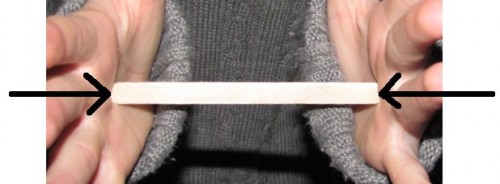
Compression is a pushing (compressing) force. The shorter a piece of wood is, the more compression it can hold. The longer a piece of wood is, the less compression it can hold. When you compress a long stick of wood you will notice that it starts to bend. When a piece of wood breaks because of compression, we say it failed from buckling. Typically the top chord of a bridge, including model bridges, will be in compression. Different truss designs spread out the force so that various internal parts will be in compression as well.
Tension:
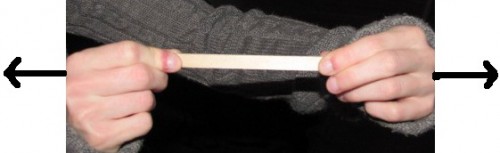
Tension is a pulling force. Wood has the ability to resist a lot of tension. It would be hard to break a popsicle stick if you held both ends and pulled apart. Tension may be applied parallel to the grain of the wood, but should be avoided perpendicular to the grain. Wood is very strong in tension parallel to the grain, but much weaker in tension perpendicular to the grain. Also, unlike in compression, the ability of wood to resist tension does not change with its length. A shorter piece of wood should hold the same amount of tension as a longer piece.
Torsion:
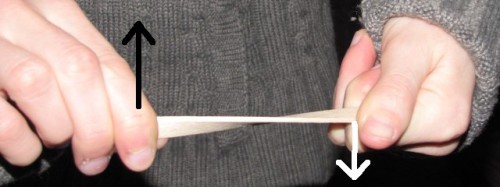
Torsion is a twisting force. When you wring out a cloth, you are applying torsion to the cloth. If you take a stick pretzel, twist one end, and hold the other end still, it will break very easily. If you do that with a baseball bat, it will not break. However, if you take a piece of licorice and apply torsion to it, the licorice will twist around several times before it breaks. Each of these materials has a different way of responding to torsion. Bridge designers must watch for torsion and try to reduce it as much as possible.
Shear:
Shear is an interesting force. It happens when there are two opposing forces acting on the same point. If you hold a piece of wood with both hands next to each other, and push up with one hand and down with the other, you are applying shear to that piece of wood. Shear usually occurs horizontally, and not vertically.
Leave any questions in the comments below.
thanks very much this helped so much
It helps a lot!!
yep
this website didn’t really help me to pass my quiz in tech.put more stuff on it. oh yeah, thanks alot.
Well, dont look at the site if it isnt gonna help
it would be time wasting
Couldn’t agree more.
OMG! this website is awesome.. but i think more info. could help more the people, but although its very helpful, thanks alot, i like alot this website! THANKYOU ALOT AGAIN!
this website has really helped me and i enjoyed reading it.
Good website. helped me to build my toothpick bridge
Cool! I’m building a toothpick bridge too
samesies
I’m building a popcicle stick 1!!
same
I still don’t quite under stand what shear is. Is it both compression and tension in a single piece of wood??? But then wouldn’t there be a neutral point? Where there is also no tension or compression in a member? Can you explain? Thanks 🙂
I’m glad to help. Shear is a force that causes parts of material to slide past one another in opposite directions. I hope I helped!!! Amazing website by thw way.
same i still don’t get what shearing is
basically its when there are two opposing forces acting on the same point
helpful very helpful!
this helped immensily great site i now have an a in science!!!
this is a great site but i cant read so maybe try more videos
thanbsk a lot tho its really helping me out
the basic info that you need for bridges. thnx 🙂
thank you, this has all the info we needed for our assignment! 🙂
Thank you so much could use a little more info but it was awesome!!
thank you so much this is an amazing website <3
thnx, can u include some stuff about stress pionts pionts and how they vary from different bridge designs
It was really good but can you show an image for shear?
Thanks i guess. But i have some questions i would like anyone to answer..
What things keep a bridge from surviving an earthquake?
How does a bridge stay standing over water or a road?
Ashley, great question. Unfortunately my model bridges don’t have to worry about earthquakes, so I have no experience. I do know that a lot of engineering goes into the design and construction of bridges to help prevent damage from earthquakes, especially in places such as California.
I’m a practising structural engineer, although I’m from Australia so I have never actually had to design for earthquakes (they don’t happen often here), however I can make a few guesses as to what is important. The first is using the assumed properties of a design earthquake (basically what the design standards, local authorities, geologists etc. tell you) such as acceleration and amplitudes of movement to determine the loads on the bridge and designing accordingly. Secondly, making sure that the bridge’s natural frequency (the frequency at which it vibrates) is far enough away from the likely earthquake vibration frequency that the bridge will not resonate and tear itself apart. Finally you need to make sure it has high ductility. A member or connection with high ductility will stretch a lot when it fails, rather than breaking immediately. This means that the structure can re-distribute loads to parts that have not failed yet (allowing the bridge to carry more load in case the earthquake is bigger than expected). High ductility will also ensure the ultimate failure of the structure will be slow and steady allowing people to leave the bridge safely before it collapses.
Thanks Skane, This is a fantastic and simple explanation of the forces acting on a bridge when affected by an earthquake. Very well written.
omg this helped me a lot on my bridge project thanks
im doing homework on forces and this helped quite a lot, all i got was gravity!! xx
This probably saved my life! THNX
A great and informative website!
thanks great info, i got an A on my paper thanks to this site, i put it in the bib
whoever wrote this website must know this is not complete. you have to write how this effects real bridges and you guys forgot BENDING FORCE!!!!!!
This website is specifically for model bridges, and does knowingly leave out many factors that engineers of real bridges must consider.
Thank you for this information. How would I cite this article? Is this a blog, or what?
I don’t want to plagiarize this website, so I want to know as much as possible at the details. Also, I am writing a weekly “essay” for my Physics class. Is there any site like this?
I wouldn’t necessarily call this a blog. Probably just follow the standard for citing an article published online. You can use the “Last Modified” date for the publishing date.
I think this would be the correct citation, in MLA format:
“Forces that Act on Bridges”. Garett’s Bridges. Garett’s Bridges, 20 April
2011. Web. Oct. 2011.If you have to use a different format (APA, for example), then I can’t help you.
I was looking for how to stop the effect of torsion and shear, but you didn’t say how to. You should include how to stop the effects of the forces when you update it!
how to calculate tension and compression?
AJ, check out the Bridge Designer
Do you know where compression, tension, torsion and shear might happen on a bridge? Or when?
By the way, this is really good.
The top chord is usually in compression, the bottom chord in tension, and the truss members vary depending on where the load is and what type of truss. Torsion might exist if the load isn’t centered and you do not have good lateral bracing. Shear could break a bridge at the point where the bridge leaves the anchor point if that member is not substantial enough.
Hi there, this is a great site! I’m participating in a competition for building a drawbridge out of 1/8″ by 1/8″ balsa wood and had a few questions that I would appreciate anyone answering. We will be testing our bridges with a Pitsco tester which applies weight to the very center of the bridge. I understand that the shorter a member the better it handles compression but I was wondering if there was a way to reduce the tension that the members will undergo and if a better truss design to do so would be the Pratt or Howe truss. Thanks again for this great site, it has been a huge help!
This website was good but it didnt really explain what affects these forces had on the bridges. that what i want to know more about .
thanks! great help for sciency stuff!
Thank you. It helped 🙂
Thanks! This helped heaps for my assignment, although it would be nice to have other materials like steel and concrete
This was very informational thanks for the help it did great on my design.
hi guys
this is awesome
This is awesome
Can you please do about the effects of forces on wood bridges
yeah they really shoud it would work
how do you prevent shear force on a bridge
please help. its for a science project
can you show tension and compression on a spaghetti bridge
You didn’t include what to do if compression or tension is acting on the bridge how to stop it
does anyone know why are their so many different names
well, we could say pulling force, pushing force, twisting force, and sliding force, but then there would still be 4 names and they are different. The pushing and pulling forces are negative and positive of the same thing, so you could have a negative pushing force instead of a pulling force. Basically, it wouldn’t be Engineering without it’s own vocabulary. As a former professor said, you can tell an expert when they describe wine like flowers or flowers like wine.
how do bridges have tension?
What is a squeezing force
That would be compression.
The answer is Torsion force
No, it is not!!
how does tension and compression help bridges
Is it really just 4 forces? I thought it was 5.
what do you mean it is only 2 forces
their are 5 but the main ones are those 4.
it is 4 because their are only 4 external forces
What can be done to prevent torsion?
What force is caused by wind?
Wind usually causes torsion, as a large bridge will begin to sway sideways causing the bridge to twist. This is an extreme example. https://www.youtube.com/watch?v=U0Z0j7ZMdHk
What two forces act on Stone?
what is the simmilarities between a suspension bridge and an arch bridge??
how can you prevent shear force
to prevent shear force, if there the object is hollow simply add a thick brace that goes diagonally in the object.
I was looking for examples as well as definitions and this didn’t really provide that
If I take a Popsicle stick and pull up and push down, I will be adding shear force. What “Me” was saying is that If you take said Popsicle stick, make it into a rectangular prism, and then add beams along the INSIDE of the prism, it will not be able to take as much shear.
How do you prevent Shear Force
to prevent shear force, if there the object is hollow simply add a thick brace that goes diagonally in the object.
Nice Jerey!
how do you stop tension
Tension forces pull and stretch material in opposite directions, allowing a rope bridge to support itself and the load it carries
Which of these forces have to do with a truss bridge and why?
What happens when tension meets compression does it just become shear?
I dont think anything will happen if both forces are equally strong but if one is stonger then the other it will just do that.
How does shear effect bridges?
Is it possible for more than one force to happen at once
you just helped with my bridge project so much bro thanks
Im working on a project about bridges where I have to build a bridge and you just showed me some of the dynamics of it
This is really cool it helped me in my stem project
This was very helpful! But I definitely think having more info would help more people. But for me, it was great! Thank you so much!!
show how moments affect structures and bridges
thanks this helped with my work!